Photo gallery
Dive into the event atmosphere and browse through the pictures from day 3.

What happens when standards meet real-world challenges? This session brought that question to life, opening with a powerful case study from Ruth Akiiki Komuntale, Managing Director of ECOCA East Africa, who showed how clean cookstoves – built to International Standards – are transforming daily life, improving health and unlocking new market opportunities.
Read more in Ruth’s thought-provoking article on standards and clean cookstoves.

Her story set the stage for a lively panel discussion that dug deeper into how standards drive real social impact. From empowering local communities and scaling innovation to creating dignified working and living conditions, speakers showed how standards support robust policymaking, and how the right partnerships can transform lives on the ground.
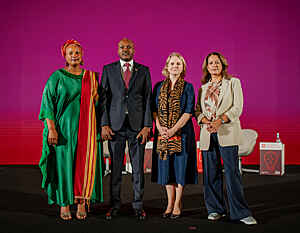
Taking the pose after the session: Ruth Komuntale, Managing Director of ECOCA East Africa, James Nkamwesiga Kasigwa, Executive Director, Uganda National Bureau Of Standards, Anna Pietikäinen, Head of Regulatory Policy Division, Public Governance, OECD, Shiulie Ghosh, Professional Moderator, Journalist, Aero Productions.
AI is transforming everything, from the tools we use to the decisions that shape our societies. A high-level session cut through the hype to explore how responsible approaches can turn today’s AI risks into tomorrow’s opportunities.
In a dynamic fireside chat, Catherine Muraga, Managing Director of the Microsoft Africa Development Center, and Hon. Yves Iradukunda, Minister of State at Rwanda’s Ministry of ICT and Innovation, explored how bold public–private partnerships can drive innovation while ensuring AI is developed in ways that are safe, responsible and inclusive.
They discussed Africa’s unique potential to shape this transformation, from nurturing digital talent to creating policies that reflect local realities and global ambitions. Both agreed that building trustworthy AI isn’t just about technology, it’s about collaboration, governance and shared responsibility

Discussing the future of AI in Africa: Catherine Muraga, Managing Director, Microsoft Africa Development Center, Hon. Yves Iradukunda, Minister of State at Rwanda’s Ministry of ICT and Innovation, and Shiulie Ghosh, Professional Moderator, Journalist, Aero Productions.
Closing the session, ISO President Dr Sung Hwan Cho underscored the vital role of International Standards in building trust, ensuring safety and scaling innovation. He called for all voices, especially those from developing countries, to be part of shaping a future where the benefits of AI are shared by all. He highlighted that this vital conversation will carry forward at the ISO/IEC Global AI Standards Summit, taking place in Seoul, Republic of Korea, on 1–2 December 2025.
One of the greatest assets we have in Africa is the median age being so low... Let us equip the youth with these AI skills.
As the Open Programme of the ISO Annual Meeting 2025 came to a close, participants gathered one last time – online and in Kigali – to reflect on an inspiring three days of ideas, debate and connection. In a newsroom-style fireside chat, ISO Deputy Secretary-General Silvio Dulinsky and Antoine Marie Kajangwe, Permanent Secretary, Ministry of Trade and Industry, Republic of Rwanda, revisited some of the week’s most powerful themes, from biodiversity and trade to social impact, gender empowerment and youth innovation.
Harmonization of standards is core to improving trade on the continent and, of course, to implementing the African continental free trade area.
Key takeaways included:

Hosting an event of this magnitude on the African continent highlighted the importance of standardization in promoting trade, investment and collaboration. As the Open Programme concluded, the focus shifted to what’s next: strengthening partnerships, amplifying impact and building on the achievements of Kigali to shape a future where standards work for everyone, everywhere.

