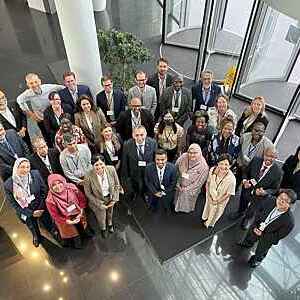
Amandeep Singh Gill, Under-Secretary-General and Special Envoy at the UN Office for Digital and Emerging Technologies, opened today the inaugural ISO capacity-building workshop on AI and standards, held in conjunction with the 2025 AI for Good Summit in Geneva.
The workshop marks the launch of ISO’s first global capacity-building journey on AI policy and standards, bringing together delegates from 16 ISO members from both developed and developing countries. It is part of a wider series of workshops that will be held in the run-up to the International AI Standards Summit 2025 in Seoul, Republic of Korea, this December.
The goal: to ensure that all countries – regardless of their level of technological maturity – can meaningfully shape and implement the International Standards that govern AI systems around the world.
UN Tech Envoy, Amandeep Gill, said:
What we need is more alignment, more discussion, more clearing, in a sense, across the work that’s happening, the development of that common vocabulary, the catalysing of that shift towards the socio-technical paradigm.
Central to this is ISO’s commitment to fostering stronger collaboration between national standards bodies, AI regulators and the global standards community. By empowering countries to systematically consider standards as part of their AI policy efforts, this initiative promotes good regulatory practices and responsible AI design and governance without hindering market growth.
Mr Gill’s presence underscored a key message running through this year’s AI for Good Summit: the governance of AI must be inclusive, coordinated and anchored in International Standards. In a world where AI technologies are evolving rapidly, many countries risk falling behind – not because of lack of ambition, but because of uneven access to expertise and institutional capacity.
Addressing the socio-technical dimensions of AI – namely, how technological systems interact with societal values, behaviours, institutions and the environment – is paramount to building trust and ensuring no one is left behind. It also lays the foundations for responsible innovation and a robust AI business community.

Amandeep Singh Gill, Under-Secretary-General and Special Envoy at the UN Office for Digital and Emerging Technologies.
Held alongside the 2025 AI for Good Summit (8–11 July), this workshop reflects ISO’s commitment to addressing the capacity divide, building momentum to the International AI Standards Summit in Seoul. It is designed to strengthen countries’ ability to navigate the complex AI ecosystem, identify key policy and regulatory gaps, and consider International Standards in the way AI is developed and deployed.
“We will be very happy to support this [Seoul Summit] from the UN because standards matter for AI governance,” said Mr Gill. “They will make sure that AI works for everyone, not just a few people. And in that context, I’m very happy that ISO, IEC and ITU are taking the lead on the Seoul Summit.”
At the heart of ISO’s approach is a simple principle: AI can only be “for good” if its governance is responsible, socio-technical in perspective, and globally inclusive. Without common frameworks and interoperable roadmaps, trust in AI will remain uneven – and so will its benefits.
The 2025 AI for Good Summit will bring together over a thousand AI experts, policymakers and innovators from across the world. Alongside plenary talks and exhibitions showcasing robotics, AI art and youth innovation, workshops like today’s are building the infrastructure of trust that AI governance demands.