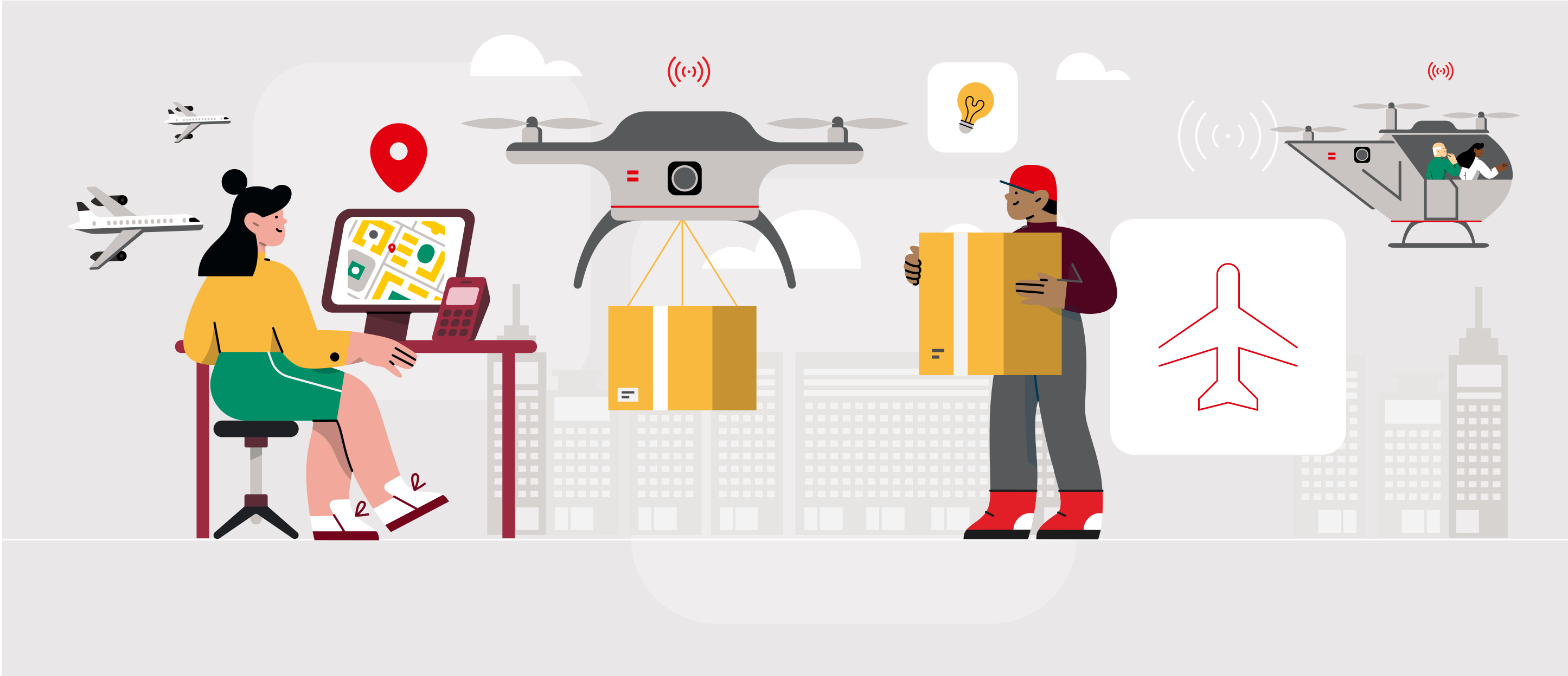

Ever caught yourself gazing up at the city skyline during your morning commute, wondering if there’s a better way to beat the traffic? The answer, as it turns out, lies in that very space above our heads. Advanced air mobility is emerging as the solution to our transportation challenges, and it’s arriving faster than you think.
Forget the old-school visions of flying cars. Today’s reality is smarter and more efficient, with electric vertical takeoff and landing (eVTOL) aircraft, highly automated delivery drones and sophisticated uncrewed traffic management (UTM) services ready to revolutionize transport as we know it. These aren’t distant concepts; they’re already being tested for operation in real-world conditions, from dense urban corridors to underserved rural routes.
Industry giants and bold startups are leading the charge, turning hour-long commutes into quick, emissions-free flights over gridlocked streets, while automated drones prepare to transform urban and regional logistics. This doesn’t just add another layer to our transportation network. It reimagines the very concept of mobility as airborne, automated and adaptive.
Intrigued? The race is on to make this vision a reality. Let’s explore how the convergence of aviation, spatial planning and digital innovation is redefining the future of mobility, across cities, regions and everywhere in between.
What is advanced air mobility?
Advanced air mobility introduces highly automated aircraft into low-altitude airspace, offering faster, cleaner and more efficient ways to transport passengers and cargo. Equipped with state-of-the-art navigation systems, these aircraft can operate with or without onboard pilots, using rooftops, vertiports and key logistics hubs across a variety of landscapes.
By cutting travel times and opening new possibilities for emergency response and short-distance travel, advanced air mobility solutions are redefining mobility in densely populated areas, as well as in suburban or rural settings.
Most advanced air mobility aircraft fall into one of three key categories:
- Electric vertical takeoff and landing (eVTOL): Combining the agility of helicopters with the efficiency of electric propulsion, eVTOLs take off and land vertically, making them ideal for urban environments. Sometimes referred to as air taxis or flying taxis, they typically carry two to six passengers, offering low-noise, high-speed transport between vertiports (specialized facilities built specifically for these aircraft).
- Electric conventional take-off and landing (eCTOL): Requiring short runways, eCTOLs provide a cleaner, quieter alternative to traditional planes, making them a viable option for both urban and regional air routes.
- Small uncrewed aircraft systems (sUAS): The backbone of drone delivery services, these autonomous systems transport light cargo with precision, revolutionizing last-mile logistics for e-commerce, healthcare and emergency supply chains.
Advanced air mobility vs urban air mobility
Urban air mobility (UAM) may be the visible face of this new era of flight, but it’s just one part of a much larger transformation. These early, city-focused solutions sit within the broader framework of advanced air mobility (AAM), which envisions a fully integrated, low-altitude airspace for passenger and cargo transport across urban, suburban and rural environments.
While UAM centres on short-distance travel – moving people, parcels or critical supplies over traffic-clogged streets – AAM expands the vision. It encompasses regional connections between towns, rural delivery networks, cross-border emergency response, and even new forms of aerial media and cargo services.
Sign up for email updates
Register to receive resources and updates on transport, mobility and related standards.
How your data will be used
Please see ISO privacy notice. This site is protected by reCAPTCHA and the Google Privacy Policy and Terms of Service apply.
Reaching for the skies
Operating below traditional flight paths, automated aircraft power a whole ecosystem of innovation. From aerospace manufacturers to fleet management services and infrastructure development, the rise of AAM is expanding economies, driving a new era of connectivity and creating jobs. This growth is guided by emerging global standards, such as ISO 23665, which defines training requirements for UAS personnel.
Here’s how aerial mobility is reshaping key sectors:
- Freight and cargo: Beyond small-scale drone delivery services, larger AAM aircraft are shaping the future of drone logistics, moving high-value goods and time-sensitive shipments with unprecedented speed.
- Medical transport: From prescription medicine to organ transfers and mobile healthcare services, advanced air mobility enables faster, more reliable access to critical care.
- Emergency response: When every second counts, AAM aircraft provide rapid deployment of first responders, medical teams and life-saving supplies in crisis situations.
- Smart city development: As advanced air mobility solutions take off, new markets are emerging for vertiports, charging stations and AI-powered air traffic management systems, guided by standards such as the ISO 23629 series.
- Urban planning: Drones equipped with advanced sensors will streamline 3D mapping, land surveying and real-time site monitoring, improving efficiency and safety.
- Security and infrastructure: From law enforcement surveillance to infrastructure inspections, drones are offering a new perspective from above. As these operations grow more automated, standards like ISO 21384-3 play a key role in ensuring safety and consistency.
And it’s just the beginning. Advanced air mobility is transforming industries on the ground while opening up entirely new markets in the sky. From regional freight to rural healthcare, AAM is changing how we connect, deliver and respond. It’s also unlocking bold new avenues for creativity and engagement – think drone light shows, floating billboards and aerial media platforms. The sky is no longer the limit; it’s the next frontier of commerce and innovation.
Software and advanced air mobility solutions
The landscape is changing fast. Aviation and aerospace leaders are in a high-stakes race to develop the next generation of highly automated aircraft: vehicles that fly entirely on their own. No pilots. No delays. No limits. At the heart of this transformation is Detect-and-Avoid technology: intelligent systems that combine LiDAR, cameras and advanced algorithms to detect obstacles and execute precision manoeuvres in real time.
But automation doesn’t stop at sensors. Behind every AAM aircraft is powerful software doing the heavy lifting, keeping flights safe, managing complex air traffic and ensuring compliance with rapidly evolving aviation standards. In this new era, software isn’t just part of the solution – it is the solution.
Several key technologies underpin aircraft automation:
- UTM systems and services act as digital air traffic controllers, preventing collisions, managing congestion and guiding AAM aircraft through complex, shared airspace. ISO 23629-12 outlines three core types of UTM services needed for safe, coordinated operations.
- Testing platforms serve as virtual proving grounds, simulating real-world conditions to evaluate aircraft performance, safety and compliance before flight. Standards like ISO 5110 define test methods for multicopters under challenging scenarios such as wind and rain.
- Predictive maintenance software is the AI-driven safety net that keeps fleets in the air. By analysing sensor data in real time, it can detect potential failures before they occur, reducing downtime and improving operational reliability.
- Compliance management tools provide the digital oversight AAM ecosystems demand. They track, audit and report performance against evolving safety regulations. ISO 23629-12 supports this process with integrated risk assessment features that enhance predictive safety and guide mission planning.
Why advanced air mobility isn’t airborne yet
The software is ready, the tech is advancing rapidly, but full-scale deployment still faces major headwinds. From infrastructure to regulation, key challenges in advanced air mobility are slowing momentum and keeping this vision grounded.
- Infrastructure bottleneck: AAM depends on a new layer of ground infrastructure, including vertiports, charging stations and maintenance hubs. But integrating these into complex transport systems, especially in cities, raises serious logistical, regulatory and financial hurdles.
- A maturing technology: AAM aircraft are evolving fast but key issues remain: limited battery range, excessive noise and emerging cybersecurity threats. Until these pain points are resolved, public adoption and large-scale deployment will continue to lag behind the pace of innovation.
- Airspace congestion: Coordinating traditional and next-gen aircraft safely requires real-time digital traffic management systems. Without seamless integration, the risk of collisions or airspace gridlock will only get worse.
- Public trust is not a given: AAM must prove it is more than a premium service for the privileged. To gain public confidence, it must integrate with existing transport systems and show real value – in emergency response, public services, infrastructure monitoring and everyday urban mobility.
Scaling advanced air mobility solutions will not come cheap. R&D, infrastructure and deployment require massive upfront investment, and bold ideas alone won’t attract funding. Investors are looking for a clear path to profitability, widespread adoption and, above all, strong regulatory support to keep the momentum going.
That’s why regulations should focus on the outcomes to be achieved – such as safety, reliability or interoperability – rather than prescribing the technologies used to achieve them. A technology-agnostic approach avoids constant updates as innovation progresses, relying on detailed technical standards to guide implementation. ISO is helping lead that effort.
From regulations to global standards
Advanced air mobility is evolving faster than regulators can keep up, and that’s a problem. Gaps in safety standards, airspace management and aircraft certification could stall progress before AAM ever truly takes off. Without coordinated action from aviation authorities, policymakers and standards bodies, the sky could become congested before it is equipped to manage it, putting the future of mobility at risk.
But it isn’t just about airspace rules. Software is central to making AAM safe, secure and scalable. Standards like ISO 26262 (functional safety) and ISO/SAE 21434 (cybersecurity) – adapted from automotive and aerospace – offer a starting point, but they weren’t designed for the unique complexities of highly automated flight.
What’s needed is a holistic, future-ready framework: one that encompasses not just the aircraft itself, but also charging infrastructure, ground sensors, vertiports and air traffic management networks, all working in sync through intelligent, connected software.
As advanced air mobility prepares to scale, the call for tailored, AAM-specific standards has never been more urgent. The launch of ISO 21384-3 was a critical first step in unmanned aircraft standardization, but it’s only the beginning. To enable safe and seamless operations at scale, we need a unified regulatory approach that evolves as fast as the technology it governs.
- ISO 23629-12:2022UAS traffic management (UTM) — Part 12: Requirements for UTM service providers
- ISO 21384-3:2023Unmanned aircraft systems — Part 3: Operational procedures
Cleared for take-off
Advanced air mobility is ushering in a technological revolution – and a global race to shape the future of transport. Aviation powerhouses like Airbus and Boeing are competing for dominance, while disruptors such as JobyElevate, Unifly and Amazon Prime Air are pushing the limits of what advanced air mobility solutions can achieve. Even automotive giants are taking to the skies. Supernal’s S-A2 air taxi is proof that the line between road and sky is blurring fast.
Success, however, will not come from the aircraft alone. Startups, military contractors and tech firms are sprinting to build the infrastructure, automation and digital ecosystems that will make it all work. Vertiports, traffic management platforms and software services will be just as critical as the AAM aircraft themselves to enable safe, efficient and scalable operations. The race is on, the stakes are high and the sky is no longer the limit – it’s the next big battleground for mobility.